Sakura
A Princess of MarsThark is an ancient, partly ruined city on Mars where a Green Martian community lives under customs that subordinate individual bonds to communal ownership and rank earned through combat. It is at once the setting of John Carter’s captivity and rise among the warriors, the home of Sola’s hidden family history, and the point from which a vast Green Martian host marches against Zodanga.
City and Community
Thark’s urban landscape includes deserted avenues, occupied buildings, a central plaza, and old towers whose ruins remain part of the community’s life. Some quarters stand vacant even while other floors house warriors, and Sola’s quarters are close enough to those assigned to John Carter that the two households adjoin. The city is therefore both a functioning settlement and a remnant of an older built world.
The community’s social practices make little room for private choice. Women and children are treated as common property, and chieftains control reproduction, while rank among warriors is measured by the metal taken from defeated opponents. John Carter learns that he stands eleventh in prowess after a killing, with ten chieftains above him; to become first, he would have to be granted combat with Lorquas Ptomel or kill him in self-defense. Authority is thus legible in the weapons a warrior carries, and personal advancement is bound to violence.
The city’s prevailing amusement further exposes the severity of this order. The Green Martians regard a prisoner’s suffering and death as entertainment, and captive Red Martians may be kept for public display at the great games before Tal Hajus. Their response to Sola’s hope that Dejah Thoris might instead be held for ransom is anger at what they regard as weakness. In Thark, compassion is not merely unusual; it challenges the values by which the community defines itself.
John Carter in Thark
John Carter’s arrival as a captive begins with a reversal: his unexpected agility changes the warriors’ first impulse to destroy him into an interest in capturing and exhibiting him. He studies their weapons and judges escape by flight too dangerous, particularly because their long-barreled rifles are designed for lethal accuracy over extraordinary distances. The city first becomes a place where he must observe, adapt, and survive.
At the warriors’ gathering, they inspect his body and expect him to perform. Unaccustomed to Martian gravity, he skips and stumbles among the furniture, then resorts to crawling; the spectacle amuses the assembled warriors. That scene establishes the physical mismatch between Earth and Mars while showing how quickly Thark turns another person’s difficulty into public amusement.
Carter’s position changes after he acquires a slain warrior’s metal. Sola tells him that this makes him a great chieftain, though still below ten others in the community’s order. When he chooses not to claim Sola as a woman and asks for quarters among the warriors, Tars Tarkas offers him a choice of vacant upper floors in a building adjoining Sola’s. Tars Tarkas notes that Carter could select women from the retinues of chieftains whose metal he wears, but Carter’s choice departs from Tharkian custom. His growing authority gives him room to act differently, even as his standing remains defined by the same combat hierarchy.
Captives and the Red Martian Mission
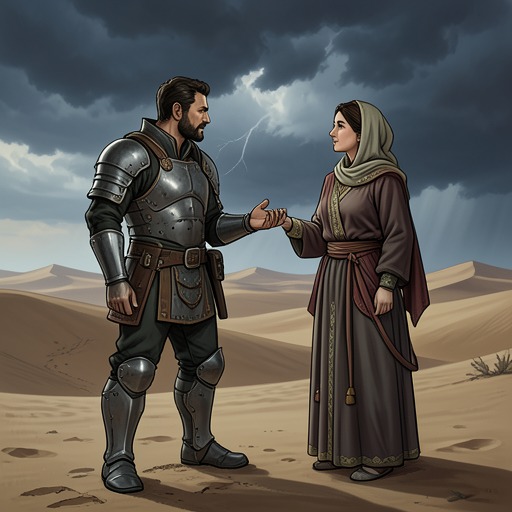
Thark’s treatment of Dejah Thoris links its internal customs to its conflict with the Red Martians. Sarkoja reports that the community will take Dejah Thoris back to Thark and exhibit her final moments at the great games before Tal Hajus. Sola objects to the expected fate and says she had hoped the captive might be held for ransom; the other women respond with anger. Dejah Thoris’s captivity thus brings the city’s customary violence into direct contact with an alternative claim for restraint.
When Dejah Thoris explains the purpose of her expedition, she identifies it as a peaceful scientific mission sent by her grandfather, the Jeddak of Helium, to chart air currents and measure atmospheric density. She argues that the work serves both Red and Green Martians: their scientific operations maintain Mars’s air and water supply despite interference by Green Martians. Her appeal asks Thark’s warriors to abandon enmity and join the Red Martians in preserving their dying planet, condemning a society without written language, art, homes, or love and urging it toward fellowship.
The appeal briefly unsettles the gathering. Lorquas Ptomel and the warriors listen in silence, and John Carter believes they are moved; he imagines that a sufficiently powerful man rising above custom might have begun a new era for Mars. Tars Tarkas rises with an expression of inner struggle against heredity and long-standing practice. The moment does not erase Thark’s established order, but it shows that the city’s customs can be challenged by an argument grounded in shared survival.
Hidden History and the March on Zodanga
Thark’s brutality is not the whole of its history. Sola recounts that her mother was considered too small for the responsibilities of maternity under a system that bred chiefly for size, and that she was less cruel than most Green Martian women. Her mother met a young warrior among the hills near Thark, where he guarded the feeding thoats and zitidars. Their attachment grew from repeated meetings and remained secret for six years, since discovery would have brought punishment before Tal Hajus and the assembled community.
Sola’s egg was hidden beneath a glass vessel on the highest, most inaccessible tower of partly ruined Thark. Her mother visited once a year during its five-year incubation, fearing that more frequent visits would expose the secret. Meanwhile, the father advanced as a warrior, taking metal from several chieftains and hoping to rise high enough to challenge Tal Hajus and protect his family. His chance was delayed when he was sent south on a long campaign against the inhabitants there. The concealed story of Sola’s birth stands against the city’s public doctrine: a family exists in secret precisely because the community denies private love and parenthood.
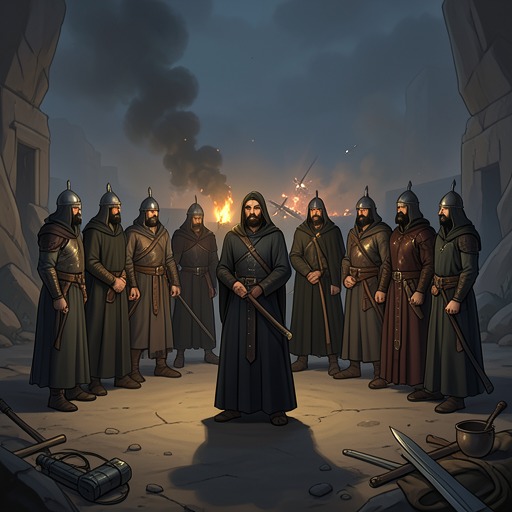
Thark also becomes the launching point for a military coalition. Tars Tarkas assembles three smaller hordes on the promise of Zodanga’s loot, and the force sets out one hundred thousand strong. They march by night and shelter in deserted cities by day; along the route, Tars Tarkas recruits another fifty thousand warriors. Ten days after departure, the host reaches Zodanga at midnight with one hundred and fifty thousand fighters. Their longstanding quarrels are suppressed by hatred of the Red Martians, especially the Zodangans, whose campaigns have targeted Green Martians and their incubators. Thark’s capacity to mobilize an immense army therefore rests on the same martial culture that orders life within the city, redirected by a common external enemy.